

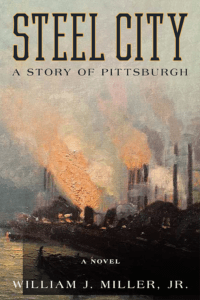
From the Publisher: “Steel City is the story of the 1890’s golden age of Pittsburgh when its technological innovations and wealth creation made it the Silicon Valley of its day. Pittsburgh was first in steel, food processing and electricity, and the leaders of those industries – Carnegie, Frick, Heinz and Westinghouse – are names we still know today.
Amid this fevered atmosphere Jamie Dalton, a recent Yale graduate and son of a corporate lawyer, must decide whether to accede to his father’s wishes and pursue a career in law or the steel business, or follow his own instincts and become a newspaperman. Witnessing the infamous Johnstown Flood, confirms his choice to be a journalist, and Jamie goes on to cover Pittsburgh’s business titans, labor strikes and assassination attempts. While reporting on the unions of the era, he is exposed to a very different world, symbolized by his infatuation with a mysterious woman under the sway of an Eastern European anarchist. Jamie struggles with balancing the access he has to Pittsburgh’s business elite while maintaining the objectivity to tell the hard truths about those same people. Ultimately, he must thwart a terrorist plot that could disrupt the massive corporate merger that would restructure the nation’s largest industry: steel.
Steel City brings you the cauldron that is Pittsburgh in the 1890s when the steel business made the city the industrial capital of not just the country, but the world. Through the eyes of Jamie Dalton, we witness the titanic events of that city in that age: the Johnstown Flood that killed more people than any U.S. natural disaster of the 19th century; the Homestead Steel Strike of 1892 when Henry Clay Frick sent in an army of Pinkertons to break the back of the labor movement; an anarchist’s assassination attempt on Frick in revenge for Homestead; the fight-to-the death between Frick and Andrew Carnegie for control of the country’s predominant steel company; and the inside story of what is still the largest corporate buy-out of all-time.
In this historical fiction novel Jamie, his father Richard, his mother Eleanor, and Pittsburgh society, high and low, navigate the social and economic issues of the late nineteenth century that still resonate today: corporate versus individual responsibility, labor relations, suffrage, income inequality, substance abuse, media ethics. From corporate tycoons and wealthy bankers to steel workers and anarchists Steel City portrays the rich panoply of that era.
This is not a gilded age novel. It’s a novel of the smoke and grit that was the pride of the booming city of Pittsburgh. Steel City takes you to another time and another world that is distant but familiar.”
More info About the Author: “William J. Miller, Jr. grew up in Pittsburgh and was always fascinated by the living connections to its storied past: the Carnegie Library and Museum, the Carnegie Institute of Technology, and, in his own neighborhood, the Frick mansion, where Henry Frick’s daughter, Helen, still lived. Mr. Miller spent his entire career in journalistic enterprises as reporter, publisher, blogger, and Time Inc. consumer marketing veteran. He graduated from the Hotchkiss School and Trinity College, Hartford, CT and lives in Watch Hill, RI and Greensboro, NC with his wife, Warren, and Havanese, Jake. This is his first novel.”
Excerpt from Steel City: A Story of Pittsburgh
The flood gained speed as it funneled down the valley. I would be behind the crest of the wave, but I needed to observe as much as I could and get to a telegraph and wire Cleveland Brooks. I stopped at South Fork and was told that the telegraph was out from Mineral Point to Johnstown. I hurried ahead knowing that I would not be in touch with Mr. Brooks anytime soon. Despite all the devastation I was seeing, it thrilled me to have the chance to prove myself.
Just below South Fork, there was a stone viaduct that had stopped the waters, and a lake formed behind it. That momentary pause allowed me to catch up with the surge. The clot of uprooted trees and mud had overwhelmed the bridge, and it was as though there was a second dam collapse. I stared in amazement as pieces of houses, even the stone from the viaduct, hurtled along. It looked like some kind of liquid battering ram. The waters were flowing even faster, and I had to urge my horse to a gallop to keep up. The flood looked like a giant wave hitting the shore, crumbling everything in its path.
The next town down the valley was Mineral Point. The townspeople had received telegraphed warnings, and hundreds of them were perched on the hillside above the river. They watched helplessly as the roiling waters obliterated their village. All the houses, even the town’s sawmill, had been sheared away, leaving only soil and rock. The clapboard, the shingles, and the contents of their houses were now part of the rampage.
I spurred my horse along the ridge to East Conemaugh, and over the roar of the river, I heard the plaintive, steady wail of a railroad whistle warning people to escape. I arrived just in time to see a thirty-foot wave of garbage level the town. Residents were scrambling up the steep side of the valley. Passenger and freight trains were stopped on sidings because of track washouts, and the conductors and engineers were urging passengers to leave the cars and get to safety. When the three-story wave hit the town, I saw passengers that hadn’t made it to the hillside dis- appear under the water. As the flood swept over the railroad yards, the freight and passenger cars were tossed about as if they were a child’s train set. The water smashed the roundhouse and swept fifty-ton locomotives downstream. Now the waters were filled with scores of railroad cars and houses. Nothing could stand up to the force of the water and the lethal objects it carried. Even worse, I saw a sign saying “Conemaugh Wire” bobbing in the water and knew what danger that portended. The barbed wire that mill produced would entangle every bit of scrap along the way to Johnstown.
Below East Conemaugh was Woodvale, a village that bordered Johnstown on its eastern end. Larger than Mineral Point, it had been built as a model town by the Cambria Iron Company. Neat, white, Cape Cod– style homes lined its symmetrical streets. There had been no warning blast to rouse the residents. As my horse and I, both panting from our race down the valley, watched, the town was reduced to rubble in less than five minutes. Houses, a sawmill, and a streetcar shed, all gone. Townspeople tried to outrun the wave of water, then one by one they all disappeared in the boiling froth. There were horses from the streetcar shed craning their necks for air before slipping beneath the surface. Across the valley I could see a sign that said Gautier Iron Works. Steam from the water hitting the boilers plumed into the sky.
More dangerous than the speed and the lethal height of the wave was what it contained: telegraph poles, railroad cars, horses, human bodies, and miles of barbed wire, certain to catch up anything in its path. I shivered in fright and raised my eyes to heaven. I had never been one for prayer, but I beseeched God to spare all the innocent people in the flood’s path.
The water was now headed straight into Johnstown, and I raced ahead to get an observation spot atop the headlands above the city. From there I could see hundreds of houses awaiting their fate. A steady stream of people headed up the paths to higher ground, but I could also see residents desperately trying to secure their property. Horses and dogs and cats ran free on the streets. Church bells tolled in unwitting anticipation of the death to come.
I could hear the roar of the waters, louder than it had been, before I saw the wave. The crest was at its highest, and the water was filled with all the detritus it had corralled on its way down the valley. It looked like a semi-solid moving wall, and I could only imagine the horror the people of Johnstown felt as they saw it bearing down on them.
The houses on the east side of the city were swept away, and from my perch I heard the cries of people clinging to their roofs and saw others swimming through the swirling waters. The flood seemed to sway back and forth on the sides of the valley, picking up speed and height with every movement. The next strike was against the solid-looking stone buildings of the downtown area. For the most part they fared no better than the homes had. The water hit them like an enormous wrecking ball. The three- and four-story buildings buckled at their foundations, the roofs tilted, then whole structures slipped beneath the waters. The First Bank of Johnstown and the Town Hall stayed standing, but that made the leveling of all the rest even starker.
Below the business area, the Little Conemaugh took a sharp right- hand turn a quarter mile before it joined Stony Brook to form the Conemaugh River. The flood raced across the peninsula created by the two streams and slammed into the side of Prospect Hill that rose up hundreds of feet from the banks of Stony Creek. There it seemed to hesitate, and the backwash lurched back into the town. It caught people by surprise who had thought they had weathered the worst and destroyed homes and buildings that had managed to survive the first onslaught. If people weren’t knocked senseless by various hard objects that had been swept back, they were pulled below the surface with a gruesome finality. Ten minutes after the first shock, the town had been destroyed.
Looking at my watch I saw that the first wave of the water had hit Johnstown at 4:07, an hour after the dam collapse. The flood roared like a gigantic beast, and a hideous black spray blocked my view of the waters below. I could still hear the ineffectual cries of train whistles trying to warn people of the fate that awaited them. There was a ferocious wind that could be felt in my perch on the bluff. Freight cars were flipping through the air. It was like the town had exploded.
After the waters backed up Stony Creek and buried Johnstown again, the flood lost some of its momentum, but it found an outlet down the Conemaugh. I saw the railroad bridge with its seven stone arches less than a half mile downstream from the confluence of the Little Conemaugh and Stony Creek and wondered whether the viaduct would hold against the onslaught of water and debris. Even at the flood’s reduced velocity, I didn’t see how it could.
But it did. The debris began to form a barrier, and I could see drowned horses and cows caught up in it. People struggled for their lives in the rushing torrent while dead bodies were tossed around like dolls. With the river still pushing them into the pile of refuse, I could see that they had no chance of escape.
This excerpt from Steel City: A Story of Pittsburgh is published here courtesy of the author and publisher and should not be reprinted without permission.
From the Publisher: "In this “smart, irreverent secret history” (Stewart O’Nan) Sewickley set novel by highly praised Pittsburgh native author Anna Read more
We’ve been celebrating literary Pittsburgh since 2015 without a break, so for the ten year anniversary of Littsburgh, we decided Read more
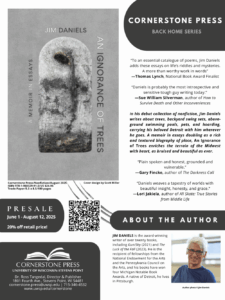
From the Publisher: "In his debut collection of nonfiction, Jim Daniels writes about trees, backyard swing sets, above-ground swimming pools, Read more
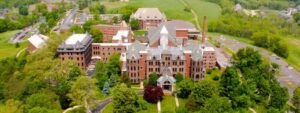
Want to get your writing mojo back? Attend Seton Hill U’s In Your Write Mind Writers conference. $120 for the Read more

New York, NY — The Community of Literary Magazines & Presses (CLMP), the national nonprofit organization that for 58 years Read more
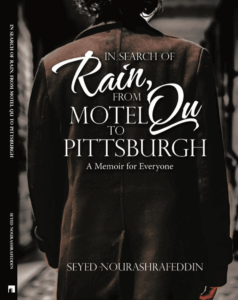
From the Publisher: "Imagine that you are a child who was born in a large family, and during your childhood, Read more

From Mt. Lebanon Magazine by way of Facebook: "On February 18, the Mt. Lebanon Public Library Board of Trustees passed Read more

"The City of Pittsburgh, with funding through the American Rescue Plan Act (ARPA), is launching the Support for Artists Grant Read more
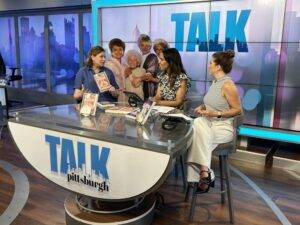
Littsburgh's founder Rachel Ekstrom Courage (now a New York Times and USA Today bestselling author!) recently stopped by KDKA to Read more

"The Drue Heinz Literature Prize recognizes and supports writers of short fiction and makes their work available to readers around Read more
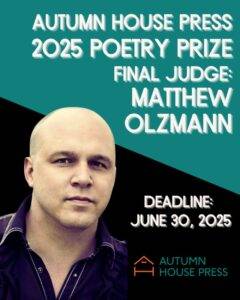
"For the 2025 prize, the Autumn House staff as well as select outsider readers serve as the preliminary readers, and Read more

"Applications are now open for Read Local Eat Local 2025! This is event is on Saturday, September 6, from 11 Read more
"What: This is an annual, alumni-run writers workshop. It features writing-related classes, agent pitch sessions, a book signing, and other Read more

"Calling all plot twisters, world builders, and romance stirrers! Join fellow genre lovers, top-tier agents, sharp-eyed editors, and bestselling authors Read more
PITTSBURGH — Prime Stage Theatre celebrates its 29th season with three world premieres commissioned from three Pittsburgh playwrights: Nov. 7-16, 2025 – Mr. Read more

From our friends at Pittsburgh Arts & Lectures: Pittsburgh Arts & Lectures’ 2025/26 roster of acclaimed authors for our Ten Read more

PITTSBURGH, PA – It’s time to book your spot! Registration for the 2025 Greater Pittsburgh Festival of Books is officially Read more
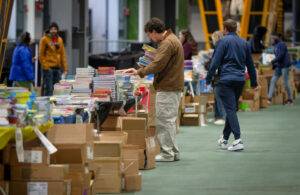
"United Way of Southwestern Pennsylvania hosted its seventh annual Big Book Drop event on April 15-17 at Acrisure Stadium, where Read more
"The Northern Appalachia Review welcomes submissions of poetry, fiction, and nonfiction written about, representing, or engaging with the experience of Read more

But this too is true: stories can save us The writer Tim O’Brien calls storytelling an essential human activity. "The Read more
