

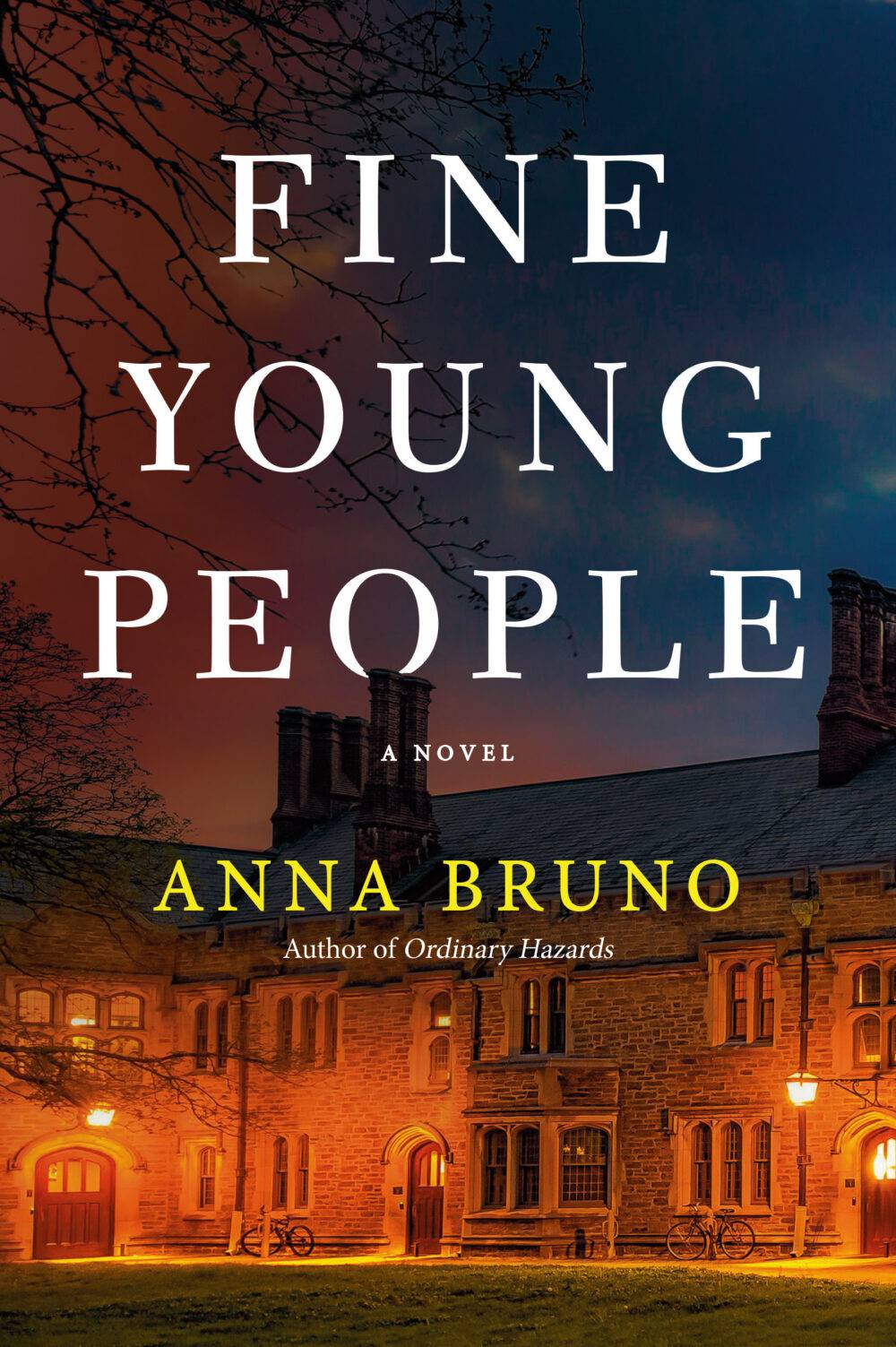
From the Publisher: “In this “smart, irreverent secret history” (Stewart O’Nan) Sewickley set novel by highly praised Pittsburgh native author Anna Bruno, a high-school senior investigates the death of a star hockey player at her elite Jesuit school, where she discovers the rot at the heart of the institution—and the truth about her own past along the way.
Frankie is a good daughter, a loyal best friend, and a model student, coasting through her final semester at an elite Catholic prep school in a wealthy Pittsburgh enclave. But acceptance to her dream college leaves her unmoored. When a classmate takes his life after posting a cryptic message about Woolf Whiting—a former student hockey player who died in a presumed suicide years earlier—Frankie and her best friend, Shiv, decide to investigate Woolf’s death as part of their journalism class project.
As the community mourns, a muffled conversation between Frankie’s mom, who teaches history at the school, and the priest who teaches her philosophy class draws the girls further into unraveling the mysterious life and death of Woolf. Frankie speaks to his sister, now a high-powered lawyer in New York; his former girlfriend, who Woolf’s mother is convinced knows more about his death than she has revealed; and his best friend. As she does, she discovers much more than she expected about the history of her supposed elite education—and the truth about her own past.
With a wry, send-up-the-patriarchy, wise-beyond-her-years narrator and a page-turning plot, Fine Young People is a cold-case mystery with a Hitchcockian twist and a portrait of a young woman searching for meaning in a world that values achievement above all else.
More info Don’t miss out: Penguin Bookshop will be hosting an evening with Anna Bruno on Saturday, August 2 at 5pm!
Event Info “Anna Bruno’s smart, irreverent secret history of the posh St. Ignatius school is a smorgasbord for Pittsburghers. At once a cozy and a coming of age novel, Fine Young People plumbs the true mystery of the Steel City—the chasm between the privileged and everyone else.”―Stewart O’Nan, author of Snow Angels and Emily, Alone
“A finely crafted meditation on family, community, class, wealth, insidious power, and the limits of religion.”―Booklist
“An engrossing mystery about the perils of belonging, how joy and tragedy can irrevocably shape close-knit communities, and the all-consuming pursuit of the truth, Fine Young People grabbed me in the first few pages and never let me go. The sparkling prose, robust character work, and expert plotting make this novel perfect for readers of Liz Moore and Rebecca Makkai. An absolute gem.”―Katy Hays, New York Times bestselling author of The Cloisters and Saltwater
“A compelling blend of literary mystery and sharp social commentary, Fine Young People follows Frankie, a student at an elite prep school, as she confronts devastating truths about privilege, power, and the secrets that have shaped her world. Bruno masterfully performs psychological suspense and coming-of-age narrative, creating a propulsive story that examines the true cost of achievement culture. Heart-grabbing, page-turning, and unflinching, Bruno holds us in her grip. An unforgettable novel.”―Chelsea Bieker, author of Madwoman and Godshot
“Anna Bruno has such a keen eye and ear for story. Fine Young People is a taut, gripping, and watchful novel–I didn’t want to put it down.” ―Claire Lombardo, New York Times bestselling author of The Most Fun We Ever Had and Same As It Ever Was
“Fine Young People is, unusually but in more than one sense, a mystery novel—not only about the mystery of a young man’s death some twenty years in the narrator’s past but about the mystery of the overlapping things, the eternal present, the mysteries of faith and grief and friendship. What might be most impressive about it is how much it manages to express without ever laboring for breath. It’s eloquent, but casual about it; moving, but casual about it; funny, but casual about it; suffused with the deep unknown, but casual about it.”―Kevin Brockmeier, author of The Ghost Variations: One Hundred Stories
“Fine Young People is a Holy Trinity of a novel: the sacred ground of Saint Ignatius ensconced in Pittsburgh’s gritty beauty and industrial history, a captivating mystery that obsessed me at every turn, and complicated, unforgettable characters. Bruno excavates long-buried, multi-layered tragedy, unravels the tangled threads that tie Catholics to their faith, and interrogates the highs and harms of elite sports culture, navigating ambition, religion, family dysfunction, young love, and enduring friendships with the grace and fearlessness of a star athlete who knows all her plays by heart.”―Katie Runde, author of The Shore
“Anna Bruno’s Fine Young People is a superbly plotted and thoughtfully populated novel about members of a sports-loving community seeking answers to mysteries old and new. In these clever pages you’ll also meet people who are healing from loss and betrayal, learning who they are and forging long-lasting friendships. This is a book for everyone.”―De’Shawn Charles Winslow, author of Decent People
1

WHEN PEOPLE ASK where I’m from, I say Pittsburgh, or, if I feel like being precise, Sewickley, a town located twelve miles northwest of the city.
The late-nineteenth-century industrialists built their weekend estates in Sewickley, to escape the choking pollution of the Steel City. Sometimes I imagine them looking back across the river with pride, observing from a distance the clouds billowing from their mills, the bridges and buildings blackened with soot, evidence of unyielding pro- duction and profits beyond even their wildest dreams.
Then I think about their kids. They breathe their clean air. They play on their safe streets. But they cannot escape the smog their fathers created, not entirely. Because kids know what’s on the other side of the river. They may not know they know, but they do. They are told, “You are so fortunate.” But it’s not really fortune, is it? The direction of the wind, the separation of the river, the gardens and the great rooms—it’s all intentional.
While the robber barons built their Sewickley “cottages,” the Jesuits built St. Ignatius on a hill above the town. Coeducational from the outset, it was a place of high ideals, a 150-acre oasis within an oasis, an institution dedicated to the formation of Character and the pursuit of Truth. At the bottom of the hill, two massive brick columns, topped with ornate ball finials, were erected to hold the iron gates to the school. The original gates remain—cast in Pittsburgh, transported by train to Sewickley, raised into place by rope and pulley. Like all gates, they are a symbol: What lies within is worth protecting.
AFTER KYLE MURPHY died, Father Michael stopped by to see my mom. When he arrived, I was sitting at the kitchen table, working on my laptop.
Father Michael didn’t normally make house calls. He was my Philosophy teacher, which alone would have made the situation awkward, but the priest vibe was next-level uncomfortable. He wore a black shirt and a clerical collar under a gray tweed jacket. When he greeted me, he pulled on his beard, which had grown long and somewhat untidy—a beard that telegraphed wisdom. In other words, he looked like a Jesuit priest, which, of course, he was.
It was Father Michael who had convinced Mom to join the St. Ignatius faculty two decades prior, when she was barely twenty-five. They often had tea in the faculty lounge and discussed books in his classroom. Occasionally, they prayed together.
It didn’t matter that I had grown up around him. Because he was a priest, he was intimidating, even though he was also soft-spoken and kind, and—I’m just going to say it—a lenient grader.
Mom offered to make tea and invited him into our small living room, just off the kitchen. I escaped to my bedroom but stayed there only until I heard the kettle sing. Then I stole to a dark perch at the top of the stairs, where I could see them and hear most of their conversation without them noticing.
At one point, Father Michael wept. Mom cried too, but I’d seen her cry many times. It was jarring to hear such a banal human emotion coming from a priest. Priests are often surrounded by criers—at funerals, during vigils, while performing last rites—and in my experience, they never, ever reveal even a smidgen of what we laypeople call sadness. Compassion, yes, consternation, sure, but never regular old sadness.
But there he was: a priest, a human being.
“Tell me, Alice, how can it be that we’ve lost another boy?”
“When Colton died, I thought, ‘Dear God, not again.’ But I never imagined . . .”
Colton Brooks took his life the spring before I started at St. Ignatius. Mom had tried to avoid the subject, because she’d wanted to protect her eighth grader from all things ugly and sad, but I’d sensed her distress. By the time I arrived on campus for my freshman year, everyone had seemingly forgotten about Colton. Life went on as if he’d never existed at all.
I heard Mom say something about “spiritual famine,” and she asked Father Michael if St. Ignatius was still the place he’d shown her when she had agreed to teach there. If he responded, it was with a gesture I couldn’t see. Then he said something about the culture, how it had tipped further from center each time deep-pocketed donors opened their checkbooks. Their conversation drifted to Woolf Whiting.
Father Michael said, “I’ve never told anyone this, because I couldn’t admit I should have done something different. Woolf came to me a few days before he died. I’d just stepped off the ice. We sat down on a bench outside the locker room, where I always unlaced my skates. He spoke about a decision that was troubling him, with an unknowable outcome, but would not go into more detail. When he looked down at his hands, I had the sense that he was the bystander at the trolley switch. But he was blind. He could not see the bodies on the tracks. He could only hear voices, or echoes of voices, and he knew if he pulled the lever something bad would happen, but it was something he needed to do.”
“Pull what lever?” Mom asked.
“I don’t know,” Father Michael said. “I didn’t ask. Whatever it was, he carried the burden alone. I had noticed that his girlfriend had stopped hanging around outside the locker room. And his friendship with Vince had gone cold.”
“Susanna.” Mom said her name like it alone was a statement of fact. I assumed Susanna was the girlfriend. Would Woolf have taken his life over a breakup? People broke up all the time. I was in the middle of—I told myself not to think about it.
Woolf had been gone for eighteen years—easy to remember because he died the year I was born; Colton had been gone just four. Even though Colton had been mostly forgotten, the memory of Woolf remained evergreen. The Woolf Whiting Memorial, a bronze plaque featuring a hockey player in motion, mounted on a waist-high stone pillar, was positioned prominently near the front entrance of the hockey arena. Players touched Woolf’s name for good luck as they walked by it. People still said Woolf was the best player to ever wear the green jersey, and that included the two St. Ignatius alums who were in the NHL.
But hockey stardom wasn’t why Mom cared so much about Woolf. I knew she agonized over her inability to reach certain students, second-guessing whether she could have given more of herself. But was she still tormented by Woolf’s death after so many years? If that were the case, I didn’t see how she could continue to wake up in the morning and whirl around the house, reciting her lessons and humming to herself, as she packed our lunches.
“What was behind that big smile?” Mom said. “Whatever it was, his own mother couldn’t see it. Maybe she was the least likely person to see it.”
“I never thought . . .” Father Michael’s voice trailed off.
“Nobody did. I worried about his sister, Madeline, sometimes. She was so . . . mercurial, I suppose. And Vince had problems at home. But Woolf sauntered around like the world belonged to him. Like he knew exactly what he wanted and how to get it.”
“I keep searching my mind for even the vaguest recollection of what I said to him that day—it would have been the last time we spoke. I couldn’t have offered any meaningful advice, since he was unable to tell me what was on his mind. After I tucked my skates in my bag and put my shoes on, we stood up. He extended his hand. I can still feel his palm pressed against my mine. He had huge, strong hands. When I looked him in the eye, I saw a young man looking forward. No missed opportunities. No regrets. I’d seen it before—pure potential.”
Father Michael might have seen me the same way. In high school, I did everything right. I was smart and reasonably outgoing. I took care of my body. I never complained. Upon reviewing my application, my college counselor referred to me as a “model student.” But potential was external, a thing other people saw. Inside lurked its less dignified germs: hunger or self-doubt; most days, both.
Toward the end of their conversation, Mom said, “Aren’t you going to tell me to read Job?”
Father Michael replied, “Are priests always so on the nose?” Then he laughed a little, which broke the tension.
I couldn’t fully make out their final exchange. Mom had moved closer to him, positioning her body next to his on the couch. I heard Susanna’s name again, and Woolf’s. Mom said, “It doesn’t change what happened, but it does have something to do with the matters beyond our understanding.” I thought she was talking about the mystery surrounding Woolf’s death. Later, I realized she was talking about the divine mystery.
But I didn’t hear what she revealed to Father Michael, and I couldn’t inquire about it directly, because I wasn’t supposed to be listening. When we were alone again, I did ask her about Woolf, who, until that night, I knew only as the legendary St. Ignatius hockey player who overdosed in the chapel.
“What was Woolf like?” I asked.
Mom squinted, as if she were trying to see into my soul, and said, “Sometimes, when kids are high-functioning, their parents and teachers don’t know what’s really going on with them.”
“But his friends must have known,” I said.
That’s when she mentioned three other people: his sister, Madeline Whiting; his girlfriend, Susanna Mercer; and his best friend, Vince Mahoney. They were the ones who knew Woolf best, better even than his parents, because parents can never really know their children, not fully, not the way they think they do.
To this day, I can’t quite explain how Woolf went from a legend I had only considered in passing to a full-blown obsession so quickly. It had something to do with Father Michael’s surprise visit. The hushed tone of the conversation. My sense that they were talking about Woolf when they should have been focused on Kyle. I suddenly saw certain forgettable moments anew: Mom crossing herself and bowing her head in prayer in front of Woolf’s memorial. The time she asked if I wanted to accompany her to bring flowers to his gravesite. (I did not.) I became aware that my mom had a private life, even though it had been there, right in front of me, all along. Mothers have secrets—such a revelation to me then!
I stayed up half the night scouring the internet for anything I could find about Woolf. I landed on websites devoted to high school hockey stats. On a subreddit about NHL players who were superstars in high school, someone argued Woolf would have been the next Mario Lemieux. What a tragedy, everyone agreed.
Few details about Woolf’s death were released to the public. He died of asphyxiation resulting from synthetic opioid overdose on a cold Wednesday night in March of his senior year. His sister, Madeline, discovered his body in the school chapel. She had exited the hockey rink to look for him at seven o’clock, just as the referee dropped the puck at center ice. His best friend, Vince Mahoney, was on the ice, protecting the net. The team played a period and a half without Woolf, before the coach received word of what had happened, and St. Ignatius forfeited. At the end of the season, Coach Danny Perone resigned.
No charges were filed in the case.
Woolf’s mother, Monica Whiting, never wavered in her pursuit of justice, begging anyone who would listen to help bring her son’s killer to account. She organized vigils on the anniversary of his death. In recent years, her announcements on Facebook garnered fewer and fewer likes.
A mother’s love is a desperate thing, never prepared to let go. I knew this because Mom and I were going through something I didn’t understand in my final months at St. Ignatius. All the walls between us, some hers and some mine, the things we didn’t talk about and pretended weren’t there, felt like they had been arranged into a maze. The only way I could get to the other side was to figure it out on my own. Why did Mom care so much about Woolf Whiting? Why was Father Michael her confidant? How well did I know my own mother, anyway?
I wondered if biological parents and their children were strangers to each other too, or if they always recognized traces of the other in themselves, even those parts of themselves they hated the most. Adopted as a newborn, I did not—do not—have that luxury. Everything Mom kept from me, from her enigmatic spiritual longings to her enduring love for a former student, felt charged, like a mystery I needed to solve.
Excerpted from Fine Young People: A Novel by Anna Bruno. © 2025 Published by Algonquin Books, July 29, 2025. All Rights Reserved.
From the Publisher: "In his debut collection of nonfiction, Jim Daniels writes about trees, backyard swing sets, above-ground swimming pools, Read more

New York, NY — The Community of Literary Magazines & Presses (CLMP), the national nonprofit organization that for 58 years Read more
From the Publisher: "Imagine that you are a child who was born in a large family, and during your childhood, Read more

From Mt. Lebanon Magazine by way of Facebook: "On February 18, the Mt. Lebanon Public Library Board of Trustees passed Read more

"The Drue Heinz Literature Prize recognizes and supports writers of short fiction and makes their work available to readers around Read more

"Applications are now open for Read Local Eat Local 2025! This is event is on Saturday, September 6, from 11 Read more

PITTSBURGH, PA – It’s time to book your spot! Registration for the 2025 Greater Pittsburgh Festival of Books is officially Read more

"The Northern Appalachia Review welcomes submissions of poetry, fiction, and nonfiction written about, representing, or engaging with the experience of Read more

But this too is true: stories can save us The writer Tim O’Brien calls storytelling an essential human activity. "The Read more
"'Where do you end and I begin?' is the question which haunts Shaheen Dil’s remarkable memoir-in-poems. Dil’s journey is at Read more

City of Asylum Pittsburgh and International Cities of Refuge Network (ICORN) collaborate to present 30+ free,transformational events over 4 days Read more
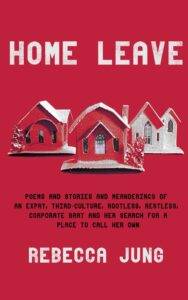
From the Publisher: "In 1958, a midwestern family was uprooted from Canton, Ohio to Bukavu in the Belgian Congo during Read more
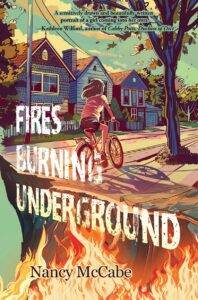
From the Publisher: "It’s Anny’ s first day of middle school and, after years of being homeschooled, her first day Read more

"A light snow fell on January 30, 2005, a typical cold Pittsburgh winter morning. Inside Calvary, the congregation had gathered Read more

We are so excited to help spread the word about the excellent Woolly Bear Books and Gifts in Carnegie, PA Read more
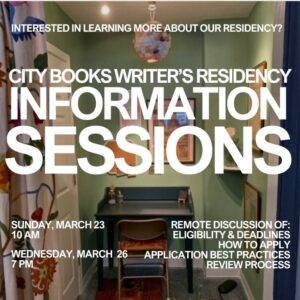
"If you have considered applying to the CBWR, or have applied in the past and not been selected, this remote, Read more

We're happy to share that Pittsburgh's International Poetry forum is sharing their latest events and performances on YouTube, where you Read more

StoryZ, a Latrobe-based theatre company founded by Artistic Director Dr. Stephen A. Schrum, announces its production of Labor’s Martyr: The Read more

ALL SKATE: True Stories from Middle Life is a series of musings from one mid-life woman, wife, and mother on what Read more
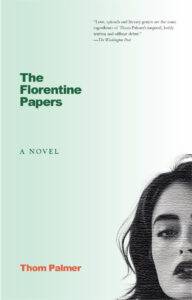
"Thom Palmer’s richly imagined first novel offers a hilarious yet bittersweet examination of food, art, and love..." From the Publisher: "When Read more
