

From the Publisher: “Daryln Brewer Hoffstot has observed the fields and forests of her Western Pennsylvania farm for thirty-five years. This collection of twenty-seven essays explores birds, mammals, bees, fungi, trees, and other aspects of the natural world. She is a keen observer who delights in sharing what she sees as well as what she learns from naturalists. Her discoveries have strengthened her commitment to protecting the plants and animals that surround us…”
More info About the Author: “Daryln Brewer Hoffstot is a freelance writer whose work has appeared in numerous publications, including the New York Times, the Boston Globe and Pittsburgh Quarterly. Her essay in the New York Times, “On a Pennsylvania Farm, Nature Is Not Just Carrying On,” won a Notable Mention in The Best American Science and Nature Writing 2021.”
Less Lawn, More Native Plants
 When my mother-in-law was ill twenty-eight years ago, my husband began to build a stone wall on our front lawn. Each rock he handled three, maybe four times: plucked from the woods, thrown into the back of a pick-up, dropped onto the grass to decide placement, or set directly atop a dry wall. One stone at a time, he dealt with his grief. Hour after hour, I saw him grimace under the weight of the boulders. I heard him groan. I wondered what were his thoughts, but I needn’t have asked him, and he needn’t have told me. Ten feet, then 50, and finally 400 feet long, the wall, I knew, was dedicated, silently, to his mother.
He left spaces in the wall for two wooden gates so we could walk to the pond, the hammock, or into the woods. Outside those gates he’s always mown the grass, but last summer, for the first time, he did not. The grasses grew tall, golden brown, and swayed in the wind. The only mown sections were three long, meandering paths–emerald green and beckoning me uphill toward the forest beyond. The vista was looser and more relaxed, the way I realized I’d always envisioned it.
Inspired by entomologist Douglas Tallamy’s book, Nature’s Best Hope, we reduced the size of our front lawn by more than half. Forty million acres of lawn exist in this country, the size of New England, with 500 square miles added each year, what Tallamy called “ecological dead space.” Since 86% of the land east of the Mississippi is privately-owned, homeowners, he believes, must preserve land “where we live, work and farm.” In 2020, Tallamy started “Homegrown National Park” an organization that encourages people to reduce lawn, plant more native plants, remove invasive plants, and add their names to an online map. As of this writing, 924 people have signed up in Pennsylvania and 23 here in Westmoreland County.
Tallamy doesn’t say we need to get rid of all our lawn. He understands lawn is nice to walk on in bare feet and that it’s a status symbol in this country, but by shrinking our lawns and growing native plants, he said we sustain food webs, store carbon, manage watersheds, rebuild soils and support pollinators. If all of us do this, whether a few acres or a 3 ft. x 7 ft. patch, we create wildlife corridors for insects, birds, and other creatures as they move around, migrate and reproduce.
Many of us have known for a while now about the importance of native plants and the decline of honeybees and monarch butterflies, but this farm has many wild areas so I think perhaps I’d given myself an ecological free pass. Then I made a list of all the ornamental plants in my flower garden and I was embarrassed. Welcome to my Asian garden, with a good dose of influence from Gertrud Jekyll and the English cottage garden: peonies, hydrangea, Japanese anemone, delphinium, hollyhock, and more. Granted we have fields and forests of Goldenrod, Aster, Spicebush, Joe-pye weed and other native plants crucial for our western Pennsylvania ecosystem, but I don’t get a free pass; we must all do our part.
I called Douglas Tallamy and was grateful he wasn’t as critical of me as I was of myself. “There’s room for compromise,” he said. “You don’t need to be 100% native.” Just increase the number of native plants in your yard, he said, and I’d be “doing a good thing.” Most people grow gardens for aesthetics and he doesn’t want people to lose the entertainment value of gardens, but a large percentage of plants from Asia is not a good ratio.
3300 invasive plant species exist in this country and 85% of the invasive woody plants come from our gardens. These crowd out our native plants, which are important because they support our native insects–and native insects, according to Tallamy, “are fussy about what they eat.” It’s not just the connection between Milkweed and the Monarch butterfly. Nettle is the host plant for the Red Admiral butterfly and aster for the pearl Crescent butterfly. Hackberry supports the Hackberry Emperor butterfly. The Double-toothed Prominent moth can’t live without our native elms. “The most important and abundant specialized relationships on the planet are the relationships among the insects that eat plants and the plants they eat,” Tallamy said.
Biologist E.O. Wilson called insects: “the little things that run the world,” and they are in peril, their numbers down 45% worldwide since 1975. Bats and hummingbirds pollinate, but it’s mostly bees, Tallamy said, which pollinate 90% of all flowering plants. And while we’ve been rallying around the non-native honeybee, we have 4000 species of native bees to protect. Three North American bumblebees are extinct already, with 25% at risk of extinction; so are 30% of grasshoppers, crickets and katydids. “By killing insects, we are biting the hand that feeds us,” Tallamy said.
But what about the bees I see sipping enthusiastically on some of my non-native plants, such as Borage, Poppies and Catmint? Tallamy explained that while such non-natives do produce nectar, they may not make the pollen that supports our specialist bees. “It takes enormous periods of time before introduced plants act like the natives they replace,” Tallamy said, what he called “a glacial rate of evolutionary change.”
Replacing non-native plants with natives–also called straight species–can be confusing, however. The first step at least was easy: finding plants native to western PA., and I did so by typing my zip code into two websites: https://www.nwf.org/NativePlantFinder/ and https://www.audubon.org/native-plants. I was pleased that I already grow some of the recommended plants, such as Monarda, Baptisia, and Phlox, but the problem is that my plants could be cultivars and, depending on how the plant is altered, might not serve our native insects as well.
Knowing the Latin name of a plant is key here, although I laugh at myself as I write this. My dear, departed mother-in-law–a great gardener who taught me a lot–urged me early on to learn a plant’s Latin name, and I scoffed, finding such advice rather highfalutin for a beginning gardener. But like many things our elders teach us, she was correct. Take Loosestrife, for instance: Lythrum salicaria is a non-native that threatens wetlands and Lythrum alatum is native and “of special value to native bees,” according to the Xerxes Society for Invertebrate Conservation.
Where then do I find the natives? Websites exist, but since I buy most of my plants locally, I wondered if my nursery or farmer’s market carry them? In an effort to garden environmentally in the past, I’ve asked big-box garden store employees whether plants contain neonicotinoids and my local farm store about purchasing peat-free compost, and both times I’ve received blank stares in return. Still, Tallamy advised me to persevere. “Ask for the straight species,” he said. “If we send the message that there’s a market for straight species, more people will carry them.”
One local nursery, Friendship Farms in Latrobe, does specialize in native plants. Joe Costello and his brother, Mike, decided twenty years ago to sell what the big nurseries did not. “We wanted to do something different,” he said. “We didn’t know it would become a ‘thing.’” The nursery specializes in large habitat plantings for such clients as the Pennsylvania Game Commission, but sells to individuals as well. He warned, however, that some homeowners don’t like the straggly look of native plants–they look better in the wild than against the house. “It takes some getting used to,” he said. “Start small and work your way up from there.”
No Mow May was begun in the UK as a citizen’s science project and adopted in 2020 by Appleton, Wisconsin when the City Council suspended their weed ordinance for the month of May. This organization urges people not to mow grass in May, which creates habitat and forage for early season pollinators. In our old cow field, No Mow May turned into No Mow June and then No Mow Summer and the field bloomed into a glorious color combination of white, purple, yellow and tan: grasses mixed with non-native Queen Anne’s lace and natives Ironweed, Goldenrod and Brown-eyed susan, good for bees and butterflies.
Nature’s Best Hope changed the way I look at the flora and fauna on this farm and I love that I can make change right here and now to help the environment. This winter, I’m making a list of what else I can do. One is to locate invasive species, such as Japanese barberry, multi-flora rose, privet and burning bush, though removal would be no easy feat. I planted none of it, but such plants have naturalized all over this farm. Another is to resist eradicating what we call “weeds,” especially Goldenrod, which support many caterpillar species. Until I read Tallamy’s book, I had no idea the importance of caterpillars to our ecosystem, particularly to bird populations. Chickadees, for instance, feed their babies 6000-9000 caterpillars for the two weeks they are in the nest. That’s one brood, in one year, by one bird species. “Caterpillars are the most important accessible currency to measure the food web,” Tallamy said. We need caterpillars!
I will rethink fall clean-up chores, including raking leaves because caterpillars pupate in fallen leaves, and I’ll try to be less tidy and leave the seed heads on such plants as Rudbeckia, good winter forage for bees. “The social edict to neaten up is often in direct conflict with the needs of our native bees,” Tallamy said.
Perhaps most important, however, is to plant more trees and shrubs, particularly what Tallamy called keystone plants–those that have the largest effect on the abundance and diversity of species in an ecosystem. “Without keystone plants,” he said, “the food web all but falls apart.” The best tree to plant is the white oak, my husband’s favorite, which he’s planted and nurtured over many years. “Oaks support more life-forms than any other North American tree genus,” Tallamy said, “including over 950 species of the caterpillars that support breeding birds.”
My husband will plant more oaks on the farm. I’ll plant keystone shrubs and flowers. Together we’ll work to make the farm a better place for all the creatures living among us–and for the humans renting the space.
One stone–or plant–at a time.
This excerpt from A Farm Life: Observations from Fields and Forests is published here courtesy of the author and the publisher and should not be reprinted without permission.
From the Publisher: "In this “smart, irreverent secret history” (Stewart O’Nan) Sewickley set novel by highly praised Pittsburgh native author Anna Read more
We’ve been celebrating literary Pittsburgh since 2015 without a break, so for the ten year anniversary of Littsburgh, we decided Read more
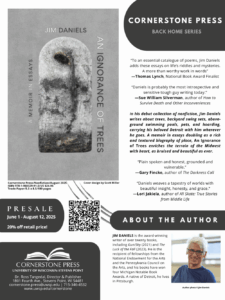
From the Publisher: "In his debut collection of nonfiction, Jim Daniels writes about trees, backyard swing sets, above-ground swimming pools, Read more
Want to get your writing mojo back? Attend Seton Hill U’s In Your Write Mind Writers conference. $120 for the Read more
New York, NY — The Community of Literary Magazines & Presses (CLMP), the national nonprofit organization that for 58 years Read more
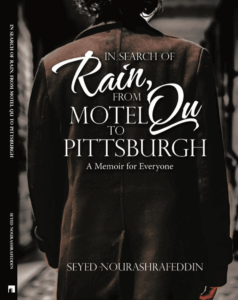
From the Publisher: "Imagine that you are a child who was born in a large family, and during your childhood, Read more

From Mt. Lebanon Magazine by way of Facebook: "On February 18, the Mt. Lebanon Public Library Board of Trustees passed Read more

"The City of Pittsburgh, with funding through the American Rescue Plan Act (ARPA), is launching the Support for Artists Grant Read more
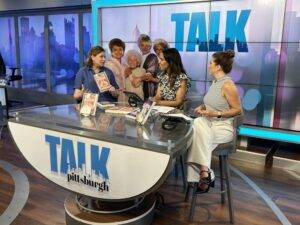
Littsburgh's founder Rachel Ekstrom Courage (now a New York Times and USA Today bestselling author!) recently stopped by KDKA to Read more

"The Drue Heinz Literature Prize recognizes and supports writers of short fiction and makes their work available to readers around Read more
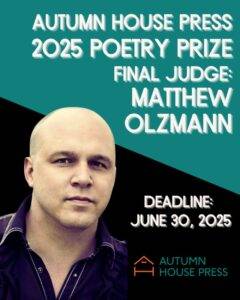
"For the 2025 prize, the Autumn House staff as well as select outsider readers serve as the preliminary readers, and Read more
"Applications are now open for Read Local Eat Local 2025! This is event is on Saturday, September 6, from 11 Read more
"What: This is an annual, alumni-run writers workshop. It features writing-related classes, agent pitch sessions, a book signing, and other Read more

"Calling all plot twisters, world builders, and romance stirrers! Join fellow genre lovers, top-tier agents, sharp-eyed editors, and bestselling authors Read more
PITTSBURGH — Prime Stage Theatre celebrates its 29th season with three world premieres commissioned from three Pittsburgh playwrights: Nov. 7-16, 2025 – Mr. Read more

From our friends at Pittsburgh Arts & Lectures: Pittsburgh Arts & Lectures’ 2025/26 roster of acclaimed authors for our Ten Read more
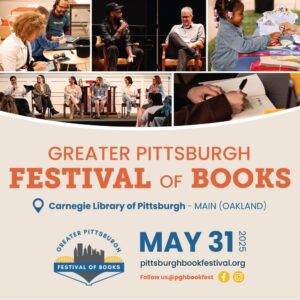
PITTSBURGH, PA – It’s time to book your spot! Registration for the 2025 Greater Pittsburgh Festival of Books is officially Read more
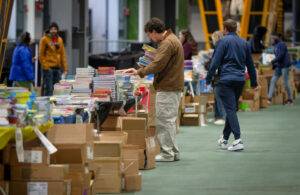
"United Way of Southwestern Pennsylvania hosted its seventh annual Big Book Drop event on April 15-17 at Acrisure Stadium, where Read more
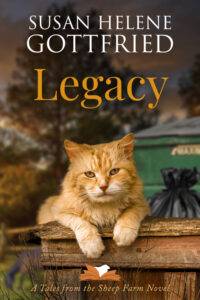
From the Publisher: "The Mackenzies and the Flahertys, two of the founding families of Port Kenneth, TN, have been feuding Read more
"The Northern Appalachia Review welcomes submissions of poetry, fiction, and nonfiction written about, representing, or engaging with the experience of Read more
